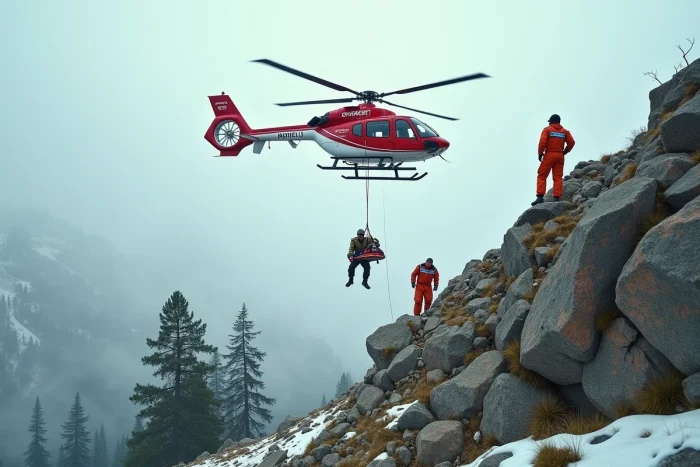
The cost of a helicopter evacuation after an accident in the mountains ranges from a few hundred euros to several thousand, depending on the duration of the flight, the difficulty of access, and the resources mobilized. The coverage of these helicopter rescue costs depends on a factor often overlooked: the exact location of the accident and the service that intervenes. Understanding this mechanism allows for anticipating a bill that, without preparation, can be quite heavy.
Rescue on ski slopes or off-piste: the billing differences table
The fundamental distinction lies in the geographical location of the accident. The coverage regime changes radically depending on whether the victim is on a developed ski area or in the wilderness, outside any area managed by an operator.
| Criterion | On ski area (slopes) | Off area (hiking, climbing, off-piste) |
|---|---|---|
| Intervening service | Rescue workers from the resort | PGHM, CRS Montagne, firefighters, SAMU |
| Free initial rescue | No – the municipality or operator charges | Yes if state public services (PGHM, CRS) |
| Search/rescue helicopter | Charged by the municipality or department | Free when mobilized by state public rescue services |
| Medical transport (SAMU/SMUR) | Reimbursed by Health Insurance | Reimbursed by Health Insurance |
| Potential out-of-pocket expense | Several hundred euros | None for the rescue, possible for transport depending on prescription |
What may be surprising is that rescue on the slopes is chargeable while those in the wilderness are often free. The explanation lies in the legal status of the responders. On the slopes, the municipality delegates the rescue to the operator, who passes on the costs. Off area, it is the state forces (PGHM, gendarmerie) that intervene, and their public service mission does not result in any direct billing to the victim.
To fully understand the distribution of these helicopter rescue costs in the mountains, it is also necessary to distinguish between the rescue itself and the medical transport to the hospital, two services subject to distinct financial regimes.
Helicopter medical transport and Health Insurance: what is reimbursed
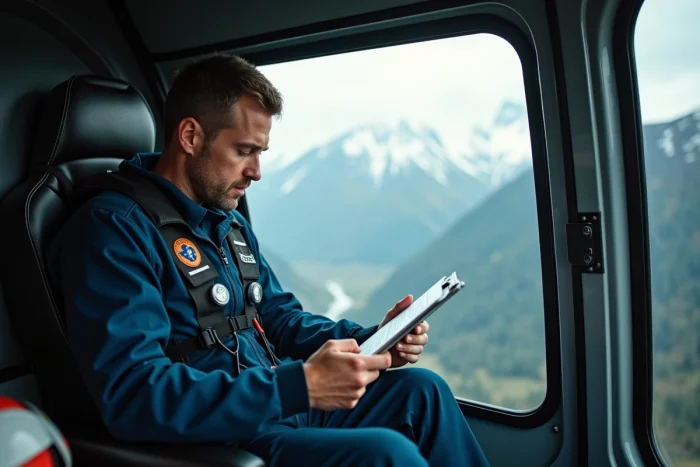
Health Insurance makes a clear distinction between two types of flights. The first concerns medically prescribed medical transport to a healthcare facility, carried out by a SAMU or SMUR helicopter. This flight is reimbursed based on conventional transport rates, just like an ambulance would be.
The second type of flight corresponds to the search and rescue phase, organized by the municipality or department. Health Insurance does not cover this part of the intervention. The bill then falls either to the victim or to their private insurer.
In practice, an evacuation often combines both phases. A civil security helicopter locates and airlifts the injured person (rescue phase), then a medical transport takes over to the hospital (health phase). Only the second phase is eligible for reimbursement by Social Security. The first, if charged, remains the responsibility of the victim or their supplementary insurance.
Municipal billing for resort rescues: a trend that is expanding
Mountain municipalities have the power to charge for rescue operations on their ski area. This practice is based on municipal decrees, and the amounts vary by resort. The recent trend, noted by the Court of Auditors in its 2023 report on civil security, shows that several departments are expanding the possibility of charging for helicopter rescues in situations deemed reckless.
The cases targeted as a priority:
- Accidents occurring off-piste in unsecured areas, in unmarked zones where the skier voluntarily ventures outside the managed area
- Interventions in areas explicitly prohibited by prefectural or municipal decree, for example after an avalanche alert
- Triggering alerts deemed abusive, when the mobilization of heavy resources results from manifestly negligent behavior
This evolution changes the situation for practitioners. A skier who stays on the marked slopes of a resort already pays the rescue costs by default. Those who venture outside the area in a prohibited zone now risk an additional charge, where public rescue was traditionally free.
The role of insurance in covering out-of-pocket expenses
In light of this reality, three levels of coverage coexist. High-end credit cards sometimes include repatriation assistance, but the limits are often low and exclusions numerous. The insurances offered by resorts at the time of purchasing the lift pass generally cover on-slope rescues, with amounts adapted to local rates.
Insurance dedicated to mountain sports, taken out with specialized organizations or via a federal license (CAF, FFME), offers broader coverage including off-piste, climbing, and search costs.
The federal license of the French Alpine Club includes mountain rescue insurance that covers search and rescue costs, including by helicopter, on French territory and in several European countries. This type of coverage remains the most suitable for regular practitioners of activities outside ski areas.
Mountain rescue abroad: very different rules depending on the countries
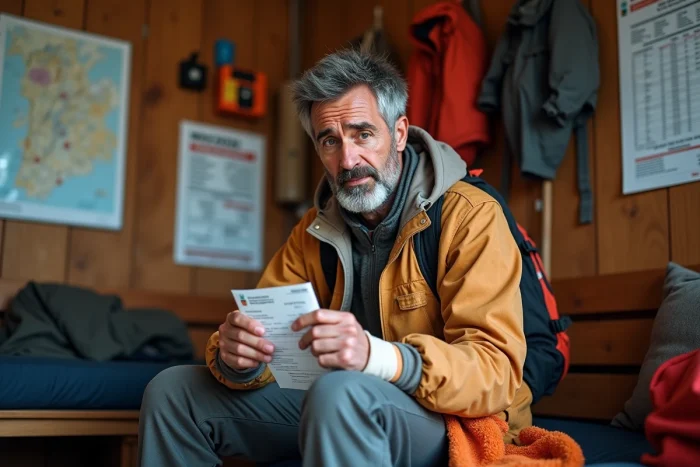
The principle of partial free rescue in the mountains is a French specificity. In Switzerland, the entire cost of helicopter rescue is charged to the victim, whether the accident occurs on a slope or while hiking. The amounts regularly reach several thousand Swiss francs. Rega, the main helicopter rescue operator, offers an annual subscription system that covers costs for its members.
In Austria and Italy, billing varies by regions and provinces. South Tyrol applies flat rates for helicopter interventions, while some Italian regions charge only non-resident tourists. This disparity makes taking out specific insurance all the more relevant before any mountain stay outside France.
The question of coverage for helicopter rescues is not limited to a simple principle. The location of the accident, the service mobilized, the nature of the activity, and the country involved create a multi-variable system. Checking one’s insurance coverage before each outing remains the only reliable way to avoid an unexpected bill of several hundred, if not thousands, of euros.