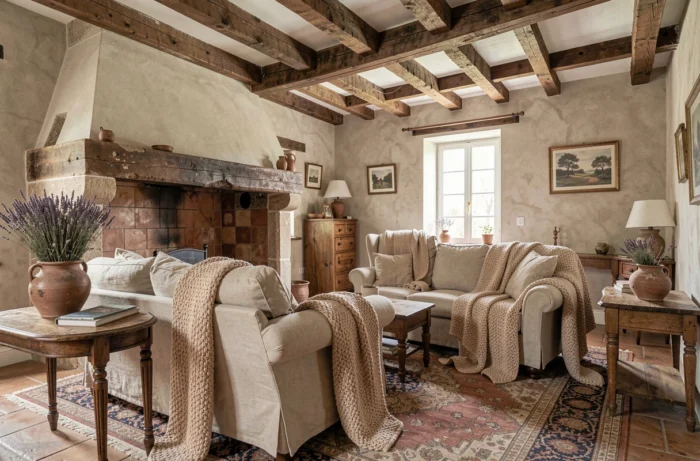
A country house is decorated with consideration for its structure. Stone walls, exposed beams, terracotta floors: these elements are not mere aesthetic details; they influence the hygrometric behavior of the building and guide the choice of coverings, colors, and furniture. Making the right assessments before choosing a shade or fabric avoids costly mistakes and preserves the charm that one seeks to highlight.
Humidity and old materials: the diagnosis that precedes decoration
Most decor guides for country houses start with colors or furniture. The real starting point lies upstream: the hygrometric balance of old walls. In a stone, earth, or timber-framed construction, certain impermeable coverings (vinyl wallpapers, glyceryl paints, waterproof linings) trap water vapor and promote condensation, mold, and even structural damage.
The Cerema recommends analyzing humidity before any work and favoring vapor-permeable solutions, such as lime-hemp or lime-earth renders. In practical terms, this means that a decorative lime render can advantageously replace a classic acrylic paint on a rubble wall, while offering a matte and textured finish that perfectly matches the country ambiance.
Specialized resources like mamaisondecampagne.fr allow for a combination of decorative inspiration and the technical constraints specific to rural buildings.
Ventilation and decoration go hand in hand
In an old house that is being insulated or made more airtight, air renewal becomes a direct health issue. Ventilation, insulation, and decorative choices must be considered simultaneously, not one after the other. An improperly sized or absent mechanical ventilation system can turn any well-kept interior into a humid and uncomfortable environment.
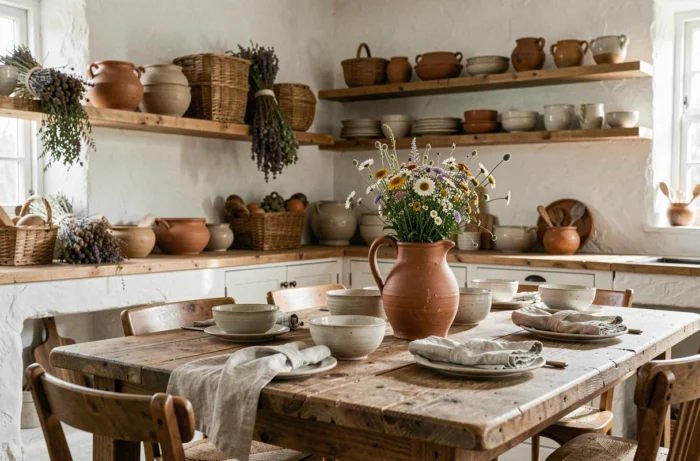
Country color palette: reasoning by natural light
The classic reflex is to choose pastel shades or off-whites. This is not always the best starting point. In a country house, brightness varies greatly depending on orientation, the size of openings (often modest in old buildings), and wall thickness.
A north-facing room with small windows benefits from warm saturated tones (ochre, sienna, olive green) rather than a cold white that will accentuate the feeling of dullness. Conversely, a living room with large windows can handle light shades and strong contrasts very well.
Compatible colors and natural renders
If your walls require a breathable render, the range of natural pigments compatible with lime is broader than one might think:
- Iron oxides provide the entire palette of ochres, reds, and browns, which are very stable over time and perfectly suited to a rustic atmosphere.
- Green earths (Verona earth, Bohemian earth) offer muted greens that pair well with raw wood and stone.
- Meudon white, mixed with lime, produces a warm, slightly powdered white, less clinical than industrial paint.
These pigments resist UV rays and do not require synthetic binders, preserving the permeability of the wall.
Wooden furniture and country charm: choosing based on actual use
Solid wood forms the foundation of country furniture. Farm tables, buffets, display cabinets: these pieces add substance and visually anchor the interior. Favoring local or reclaimed wood enhances coherence with the location and limits stylistic dissonances.
A often overlooked point is sizing. Rooms in old houses rarely have standardized proportions. A sofa that is too deep in a narrow living room or a table that is too high compared to vintage chairs creates daily discomfort that visual charm cannot compensate for.
Combining rustic and contemporary pieces
Contrast works better than uniformity. A raw oak farm table gains presence when surrounded by chairs with clean lines rather than rustic replicas. The mix of eras avoids a folkloric museum effect and provides a more personal interpretation of the space.
The same logic applies to lighting: a contemporary pendant light above an antique piece creates a focal point without overwhelming the room. Brass or wrought iron fixtures remain safe bets, provided they are not multiplied to the point of turning the living room into a historical reenactment.
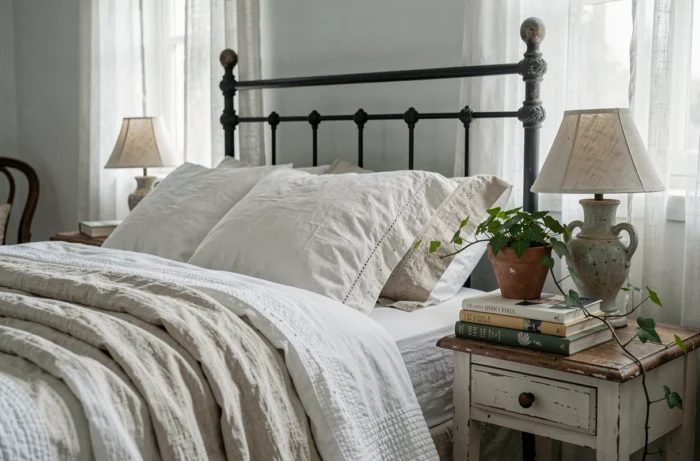
Heritage constraints: what outdoor decoration does not always allow
When the country house is located in a remarkable heritage site or near a historical monument, certain modifications visible from the outside require the opinion of the Architects of the Buildings of France. This concerns the replacement of windows, modification of the facade render, roofing, or even the installation of certain equipment.
Checking the heritage perimeter before starting work avoids administrative refusals later on. This constraint also guides interior decorative choices: if the exterior woodwork must maintain a traditional profile, it is better to integrate this consideration into the overall reflection rather than discovering it during the work.
Adapting the interior style to imposed elements
Painted wooden shutters imposed by heritage, stone lintels to be preserved, irregular ceiling heights: these constraints become decorative assets when embraced. A stone lintel highlighted by grazing light transforms a regulatory obligation into a character element. The irregularities of old buildings, far from being defects, give each room an identity that decoration should enhance rather than conceal.
The success of decorating a country house relies less on choosing a style than on understanding the building that houses it. A stone wall breathes, a heritage window imposes its proportions, and a terracotta floor dictates its palette. Starting from these concrete data produces a more coherent, and often more durable, interior than any trend applied indiscriminately.