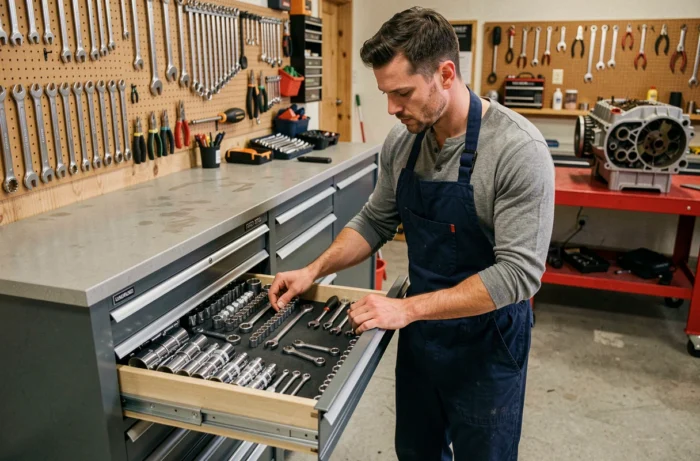
A professional garage is not built by simply stacking catalog equipment. The choice of each piece of equipment determines the intervention rate, the safety of operators, and the ability to handle recent vehicle architectures, particularly high voltage. Here, we detail the technical trade-offs that separate a functional workshop from a mere cluttered space.
High voltage lockout and quarantine area: the prerequisite that catalogs overlook
A garage that accepts electric or hybrid vehicles without having planned the associated safety infrastructure exposes itself to lethal risks and regulatory non-compliance. The issue goes beyond just purchasing insulating gloves.
The high voltage electrical lockout requires a calibrated voltage absence tester for the levels encountered on battery packs, individual lockout padlocks for each technician, and a physical delineation of the work perimeter. Without appropriate authorization for the type of intervention, no technician should approach an orange circuit.
Beyond insulated tools, we recommend planning for a fireproof quarantine area for defective batteries or damaged vehicles. This confined space, separate from the rest of the workshop, must have a fire-resistant floor and clear access for emergency services.
Professional lift: choose lifting technology before capacity
The usual reflex is to compare lifts based on their load capacity. This is a hierarchy error. The lifting technology (hydraulic with cylinder, screw, electromechanical) determines the frequency of periodic checks, maintenance costs, and compatibility with your slab.
A two-column electro-hydraulic lift remains the standard for general mechanics. Its lifting speed and ground clearance are suitable for the majority of interventions. For geometry or heavy utility vehicles, the four-column lift with platforms offers unmatched stability, at the cost of a significantly larger footprint.
The catalog available at equipotto.fr allows you to compare lifting technologies based on workshop constraints, avoiding common sizing errors when equipping for the first time.
Mandatory periodic checks
The frequency of checks depends on the lift technology, not just its age. A mechanical screw lift and a hydraulic lift do not have the same wear points or the same intervals for regulatory inspection. Check with your control organization for the deadlines applicable to your exact model, and keep the safety register up to date.
Compressed air supply: size the network, not just the compressor
Buying a high-capacity compressor without designing the distribution network is like installing a powerful engine in an undersized chassis. We regularly observe workshops where pressure loss in the pipes negates the benefits of a high-performance compressor.
- The diameter of the main network must be calculated based on the combined flow of tools likely to operate simultaneously (impact wrench, blow gun, paint gun), not just the most demanding tool.
- Quick couplings in cascade degrade flow at each connection. Prefer a closed-loop network in aluminum or galvanized steel, with individual drops equipped with automatic drain valves.
- The refrigerated air dryer is not a luxury: residual humidity damages the internal mechanisms of pneumatic tools and causes defects in bodywork and painting.
A well-designed network during installation avoids costly reworks. Integrate it into the initial layout budget rather than treating it as an addition.
Flow management and handling: what distinguishes an efficient workshop
The physical layout of the workshop weighs as much as the quality of the tools on daily productivity. It is necessary to separate pedestrian and vehicle traffic, provide a drop-off area for disassembled parts, and use mechanical assistance for heavy loads.
In practical terms, this means integrating a circulation plan with floor markings, mobile access for heavy sub-assemblies (gearboxes, running gear), and hoists or cranes near workstations right from the design phase.
Hand tools: streamline rather than accumulate
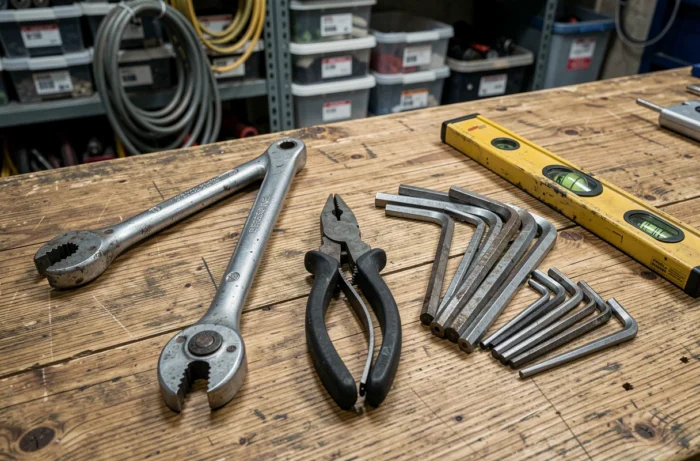
A set of torque wrenches covering the torque ranges actually used in your specialty is better than three incomplete generic toolkits. We recommend building the toolbox starting from the most frequent interventions, then adding specific tools as activity progresses.
- Torque wrenches with calibration certificates (to be recalibrated according to usage frequency)
- Socket set in 1/2″ and 3/8″ covering common automotive metrics
- Bearing pullers and ball joint separators suitable for the vehicles being serviced
- Clamp meter and minimum category III multimeter for electrical diagnostics
Electronic diagnostics: the tool does not make the diagnosis
A multi-brand diagnostic tool without ongoing training loses its value in two years. Communication protocols evolve, fault databases are updated, and embedded network architectures (CAN FD, automotive Ethernet) require compatible interfaces.
Before investing in a high-end tool, check the manufacturer’s update policy: annual license cost, coverage of Asian brands, support for ADAS systems. A cheaper tool that is regularly updated outperforms a premium device stuck on a single model year.
Each station in a professional garage (lifting, compressed air, diagnostics, high voltage safety) interacts with the others and with the layout of the space. The obligations related to charging stations in non-residential buildings with more than twenty parking spaces, applicable since January 1, 2025, add an additional layer to anticipate from the design phase.