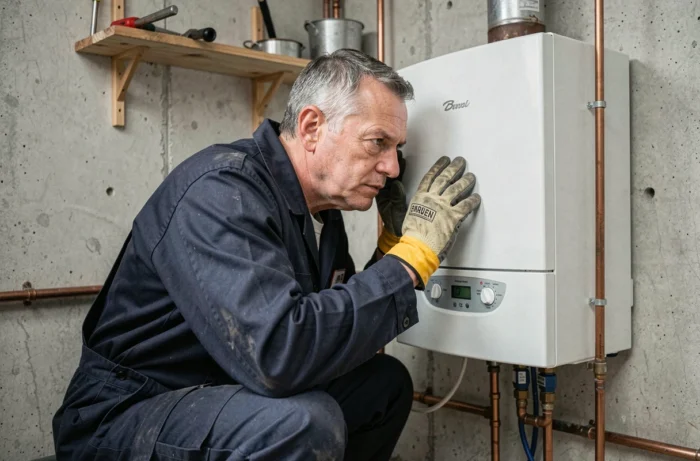
A boiler that starts to whistle, bang, or vibrate often generates more concern than the problem warrants. The opposite is also true: some seemingly harmless noises mask a combustion defect. Identifying the sound source helps distinguish a simple acoustic nuisance from an anomaly that requires prompt intervention. Boiler noises can also reveal a safety issue related to carbon monoxide.
Safety and combustion: noise as a gas alert signal
Most articles dedicated to boiler noises focus on mechanical components (circulator, valve, heat exchanger). This approach overlooks a crucial aspect: an unusual noise can betray a combustion defect.
During the annual maintenance, measuring carbon monoxide in the ambient air allows for an assessment based on three levels: normal operation, anomaly requiring further investigation, or danger necessitating immediate shutdown of the unit. This framework, outlined in the Environmental Code (articles R.224-41-4 to R.224-41-9), directly links combustion quality to occupant safety.
A high-pitched whistle at the burner, for example, is not just a comfort issue. It can signal an imbalance between gas supply and air intake, affecting combustion. As noted on infosdujour.net on boilers, these sound manifestations deserve a diagnosis that goes beyond simple mechanics.
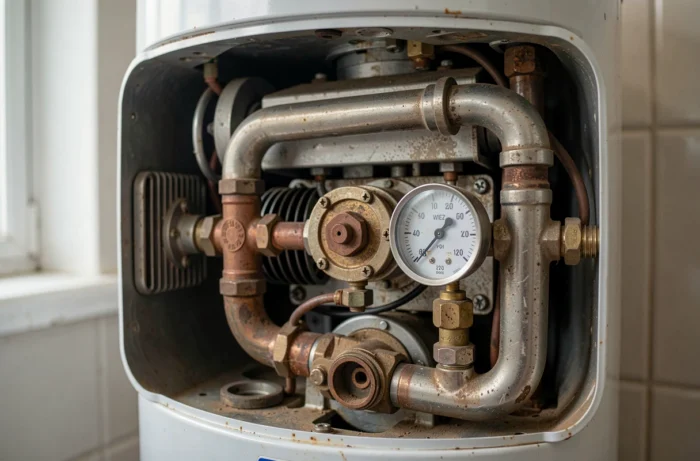
Boiler whistling: pressure, flow, or draft
The whistle is the noise that triggers the most calls to heating engineers. Its origins are varied, and the response depends on its precise location in the system.
Whistling at the heat exchanger
A whistle coming from the heat exchanger is often related to scaling. In areas with hard water, deposits gradually reduce the water passage section. The water flow decreases while the local temperature increases, causing partial boiling and a characteristic sound similar to that of a kettle.
This phenomenon, sometimes referred to as “kettling” in technical literature, cannot be resolved by adjusting the circuit pressure. It requires descaling of the exchanger, or even its replacement if the deposits are too significant.
Whistling in the piping
When the whistling seems to come from the pipes rather than the boiler itself, the problem is often hydraulic. A partially closed thermostatic valve or a tight bend in the heating network can create a restriction that accelerates the flow locally. The sound usually disappears by fully opening the relevant valves or reducing the circulator speed.
Clanging and water hammer in the heating circuit
Clanging differs from whistling by its intermittent and sometimes violent nature. Two main causes explain the majority of cases.
- Air trapped in the circuit: air bubbles circulate with the water and cause shocks against the walls of radiators or pipes. A methodical bleeding of the system, starting with the radiator farthest from the boiler, generally suffices to eliminate the problem.
- Thermal expansion of pipes: copper pipes expand when hot water flows through them and then contract upon cooling. If a pipe passes through a wall without sufficient clearance, it bangs against the structure with each heating cycle.
- Hydraulic water hammer: the sudden stop of the circulator or the rapid closing of a valve creates a pressure wave in the network. This phenomenon, recognizable by a sharp and loud noise, can damage fittings if nothing is done. Installing a water hammer arrestor or a properly sized expansion tank absorbs these surges.

Boiler vibrations: circulator, mounting, and flue
Vibrations are duller than whistling or clanging. They propagate through walls and floors, making their location difficult without direct examination of the unit.
The circulator is the first component to check in case of continuous vibration. This pump, which circulates water in the system, can vibrate abnormally if its shaft is worn or if its speed is improperly set relative to the required flow. Sometimes, reducing the circulator speed by one notch resolves the issue without heavier intervention.
The wall mounts of the boiler also play a role. A loose bracket or a degraded vibration isolator transmits the normal vibrations of the burner to the wall, amplifying them through resonance. This type of nuisance is sometimes confused with an internal defect when it is actually a mounting issue.
Vibration related to the flue
A rarely discussed aspect concerns the flue. Since decree no. 2023-641 of July 20, 2023, the cleaning of flues is subject to a national framework requiring cleaning at least every twelve months. Boiler maintenance and flue cleaning are two legally distinct operations, resulting in separate documents: maintenance certificate for the unit, cleaning certificate for the flue.
A partially obstructed flue alters the draft and can cause vibrations at the connection with the boiler. Field reports vary on the intensity of the noise generated, but the link between flue fouling and noise disturbance is documented by flue cleaning professionals.
When to call a heating engineer for boiler noise
Not all noises warrant an emergency call. A click at the burner startup, a slight hum from the circulator, or a brief gurgle after a bleed are part of normal operation.
However, three situations require immediate intervention:
- A continuous high-pitched whistle that intensifies with rising temperature, likely indicating advanced scaling of the exchanger
- Repeated clanging accompanied by a visible drop in pressure on the gauge, indicating a leak or a fault in the expansion tank
- Any unusual smell associated with abnormal noise, which may signal a combustion problem requiring immediate shutdown of the unit and a check of carbon monoxide emissions
Noise diagnosis remains a useful first filter, but it does not replace the instrumented measurement performed during the mandatory annual maintenance. A qualified heating engineer has the tools to quantify what the ear can only estimate.