
A 50 cc scooter has never been allowed on a fast lane or an express road, even when the departmental road crosses the heart of a city. Emergency stopping on the roadway? The high-visibility vest comes out of the seat, otherwise the penalty falls immediately.
For short trips as well as unexpected detours, the law remains the same: approved gloves, certified helmet, reflective devices. The power of the two-wheeler, the age of the rider, the category of the license: each parameter weighs in the balance and conditions access to departmental roads.
Riding a scooter on a departmental road: what you need to know
Each departmental road, this ribbon connecting villages and suburbs, sees scooters of all ages passing by every day. However, riding a scooter on a departmental road is never a matter of chance. The regulations leave no room for approximation: whether thermal or electric, each model is subject to strict rules designed to protect all users.
On the speed side, the rule does not bend. A 50 cc stops at 45 km/h, regardless of the condition of the road. More powerful scooters obey the local limit, rarely exceeding 80 km/h on this type of road. Between confusion and misunderstanding, some confuse national and departmental roads: as a result, an impromptu check can end with a formal fine.
The license does not make exceptions: for drivers born in 1988 or later, BSR or AM license is mandatory, without exception. Electric scooters do not benefit from any exemptions. Ecology does not exempt from checks.
Here are the essential rules for traveling on these routes:
- Registration is mandatory for all, regardless of engine size.
- Liability insurance is non-negotiable: failure to comply leads to criminal prosecution.
- Approved helmet and certified gloves are required, regardless of the weather or distance traveled.
The departmental road does not make exceptions. Those who want to delve deeper can consult the file “Scooter: Can it ride on a departmental road? – Auto Maniacs,” a reliable source to better understand the obligations to be respected.
What traffic rules and limitations apply to scooters?
On departmental roads, every scooter trip falls within a precise legal framework. The first milestone: speed. A 50 cc must never exceed 45 km/h, unless otherwise indicated. For more powerful scooters, the general limit prevails, often capped at 80 km/h. Forgetting the display, ignoring the signage: the penalty comes quickly, especially during frequent checks by law enforcement.
The technical inspection, long discussed in Brussels and Paris, is not yet imposed for scooters. France is slow to take this step, but the condition of the vehicle remains under surveillance: lighting, brakes, noise, everything can be checked. For those born from 1988 onwards, passing through driving school and obtaining the BSR or AM license is imperative to take the handlebars.
Here are the essential obligations that govern scooter traffic on these routes:
- Registration and insurance: each scooter, whether fueled by gasoline or electricity, must display a readable plate and be insured for liability.
- Regulatory equipment: approved helmet, certified gloves, and reflective vest are mandatory in case of emergency stops.
- Access to express roads and certain national roads remains prohibited. Slow vehicles have no place there.
A minor infraction is enough to receive a fine or have your two-wheeler immobilized. On the departmental road, safety admits no compromise: every trip involves sharing the road with motorists and heavy trucks. Being impeccable becomes a daily necessity.
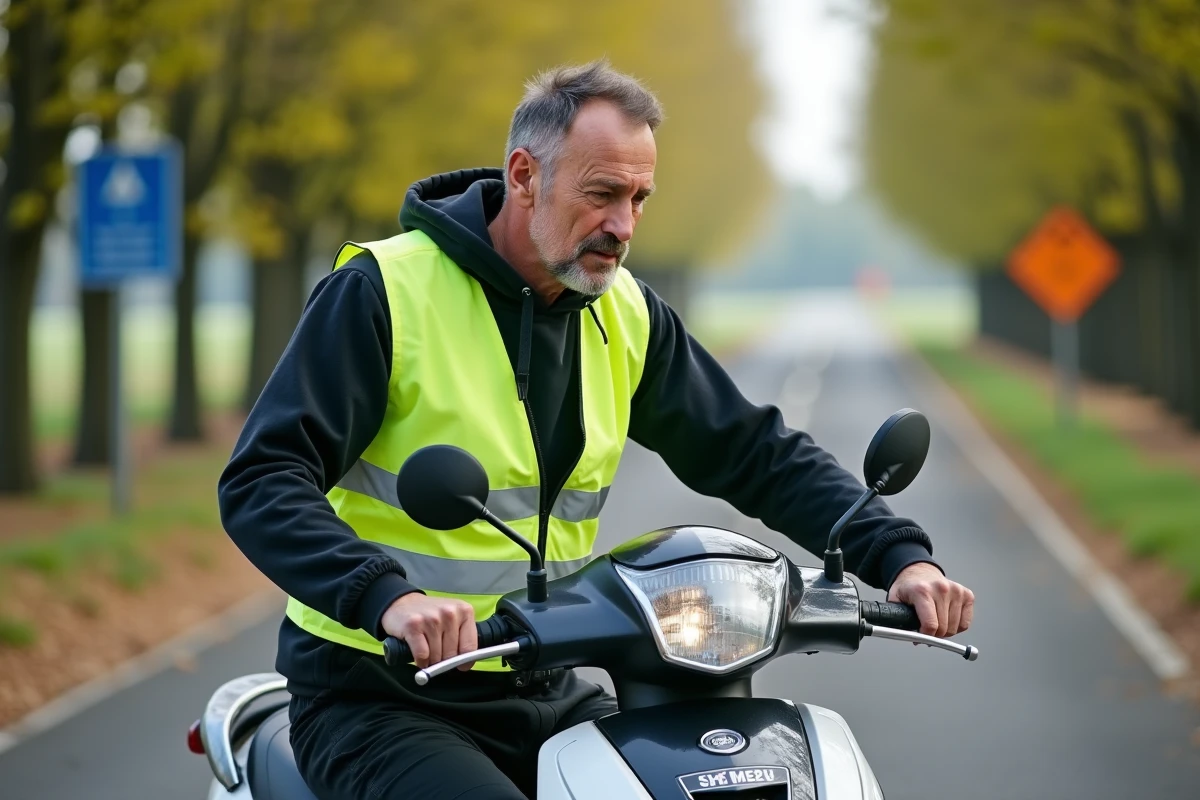
Safety and obligations: how to ride legally and avoid penalties
Taking the departmental road on a scooter or electric scooter means accepting strict rules designed to ensure everyone’s safety. Vigilance is not an option: obeying the law remains the only way to avoid unpleasant surprises.
An approved helmet is fundamental. But the list does not stop there: certified gloves are mandatory, a fluorescent vest must be within reach for any emergency stop, closed shoes. Forgetting any of these elements exposes you to an immediate penalty during a roadside check.
Liability insurance is also on the list of absolute obligations. A lack of insurance, a forgotten document: the penalty never waits long. Law enforcement also inspects the overall condition of the vehicle: brakes, lighting, noise, no detail goes unnoticed. Even if the motorcycle technical inspection is not yet in force, the demand remains high regarding the technical reliability of the scooter.
To limit risks, a few checks are necessary:
- Ensure that the license plate is readable and securely attached.
- Scrupulously respect speed limits and specific overtaking rules for departmental roads.
Taking these requirements lightly is like playing with fire: fines, immobilization of the scooter, or worse. On the departmental road, legality cannot be improvised: every detail counts, every oversight has a cost. Respecting the rules ensures you ride with peace of mind, ready to face the road… or the next check.