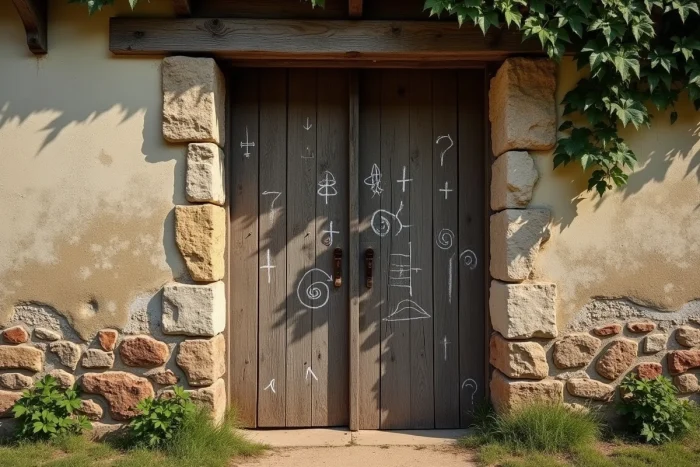
The symbols drawn on facades or door frames in certain neighborhoods do not belong to a universal mystical alphabet. They are social markers whose primary function is orientation: to signal a passage, possible hospitality, a danger, or a prolonged absence. Reducing these practices to a “secret Romani code” amounts to imposing a single framework on uses that vary according to groups, periods, and territories.
Functional Typology of Marks on Dwellings
We observe three main categories of markings on facades, each responding to a distinct logic. The first pertains to social orientation and safety: simple crosses, vertical lines, or grouped dots serve to indicate to group members whether a place is welcoming, hostile, or already visited.
The second category concerns family memory. Some marks indicate a recent mourning, a marriage, or a departure. They function as temporal markers intended for itinerant relatives who might pass by later.
The third category, most often fantasized online, encompasses protective or propitiatory signs. Their presence is attested in certain groups, but their meaning varies considerably from one family to another. An in-depth article detailing the meaning of Romani symbols confirms this diversity of interpretations according to local contexts.
- Orientation marks (crosses, arrows, dots) inform about the occupants’ attitude towards itinerant visitors.
- Memory marks (crossed lines, circles) document a recent family event, readable only by those who know the group’s convention.
- Protective marks (floral symbols, stylized horseshoes) pertain to local beliefs and do not constitute a homogeneous system.
Intergenerational Transmission and Adaptation to the Context of Sedentarization
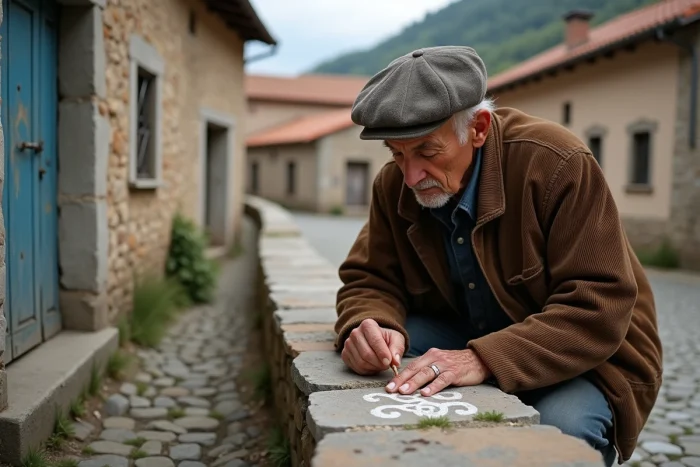
Recent research in Romani anthropology shifts the focus from “decoding” to transmission. The meaning of a sign depends more on the social context than on a fixed code. The same diagonal line can signal a hospitable home in one region and a warning in another.
The gradual sedentarization of some Romani families has altered these practices. In reception areas or suburban neighborhoods, visible markings on facades often disappear in favor of more discreet signs (stickers, objects placed on window sills, arrangement of flower pots). The function remains the same; the medium changes.
This adaptation illustrates a point that mainstream content often overlooks: symbols are not a fixed heritage but a living tool. Parents pass on useful conventions, abandon those that have become obsolete, and create new ones according to their neighborhood. A child rarely learns a complete “alphabet.” They integrate the few relevant marks for their family and their travel circuit.
The Role of Women in the Perpetuation of Markings
In several documented groups, it is the women who create and interpret domestic marks. This responsibility fits into a broader role of managing relationships between families and the inhabited space. Transmission occurs through direct observation, rarely through formal verbal explanation.
This mode of learning explains why two members of the same group may give slightly different interpretations of an identical sign. There is no centralized authority that fixes meanings.
External Projections and Misleading Online Content
A significant portion of viral articles and videos dedicated to “Gypsy symbols” mixes Romani traditions, occultism, and general folklore. We regularly find interpretative frameworks presented as exhaustive, with fixed correspondences between a sign and a unique meaning. This type of content does not reflect any practices verified by field research.
Social sciences now recommend distinguishing three levels:
- The documented practice, evidenced by ethnographic surveys of families (interviews, participant observations).
- The local interpretation, which varies from group to group and from generation to generation, without universal value.
- The external projection, constructed by non-Romani observers who impose esoteric or criminological frameworks without empirical foundation on these signs.
Methodological Caution in Romani Anthropology
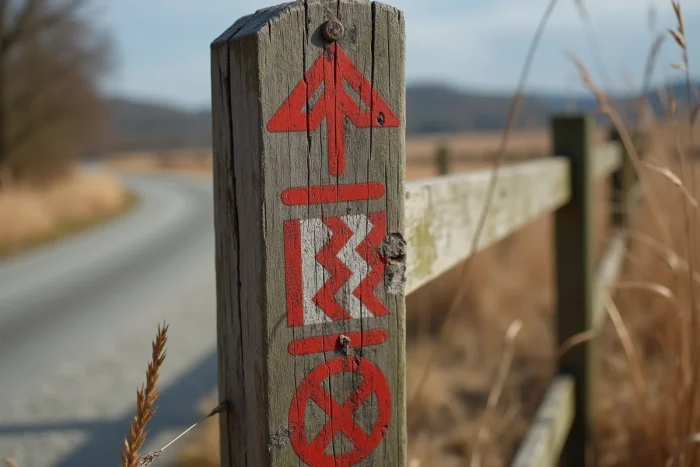
Oral testimonies, local practices, and external representations do not always overlap. A researcher in anthropology collecting testimony about the meaning of a chalk-drawn cross may sometimes receive contradictory answers within the same family. This variation is not a flaw in the system: it reflects its adaptive nature.
No universal dictionary of Romani symbols exists, and any source claiming to provide one should be approached with caution. The subject deserves an approach that respects the diversity of Romani groups (Manouches, Gitans, Roms, Yéniches) without merging them into a single category.
Marking Houses and Family Memory: What the Field Reveals
In the field, the most frequent marks are neither mystical nor criminal. They serve a function comparable to that of a shared address book: who lives here, what welcome to expect, what recent event has taken place. This pragmatic dimension is often overshadowed by the fascination with “secrecy.”
Family memory plays a central role. Some families maintain the habit of marking a threshold after a death across several generations. Others have abandoned any visible marking practice since their permanent settlement in a fixed dwelling. The gradual disappearance of certain signs is as significant as their presence.
Approaching these symbols without reducing them to a fixed catalog allows for understanding their real function: maintaining a link between geographically dispersed families in a context where writing has not always been the primary means of communication. For the groups that still practice it, marking houses remains a tool of family cohesion far more than an esoteric ritual.