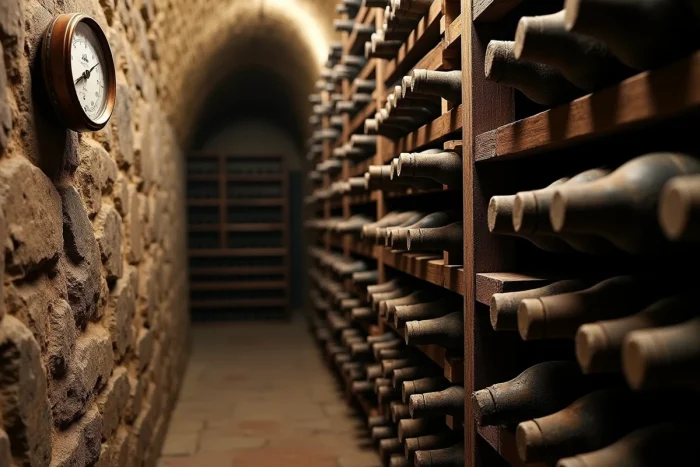
You open a bottle that has been kept for several years, and the wine seems flat, lacking depth. The problem does not stem from the vintage or the estate, but from the temperature at which this bottle has aged. A few degrees of difference are enough to accelerate or slow down the chemical reactions that give wine its complexity. Understanding the exact role of temperature in a wine cellar helps avoid this type of disappointment.
Thermal stability: the criterion that most guides underestimate
Content on wine storage often repeats a broad range, between 10 and 14 °C. This benchmark is correct, but it masks a much more determining parameter: the consistency of this temperature over time.
A cellar that fluctuates from 10 °C at night to 16 °C during the day subjects the wine to repeated micro-expansions. The liquid slightly expands due to the heat and then contracts. This movement stresses the cork, which eventually allows air to enter. The wine oxidizes, loses its fruity aromas, and develops flat notes.
Recent high-end electric wine cellars aim for a maximum variation of 1 °C around the set point. Beyond that, some manufacturers consider that the regulation system has a defect. If you have a natural cellar (in a basement, for example), knowing what temperature for a wine cellar remains a good starting point, but checking the stability over several weeks with a data logger provides much more useful information than a one-time reading.
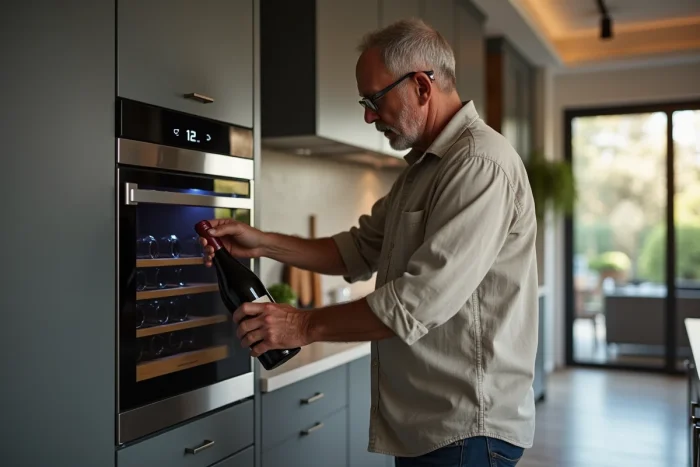
Under-stair cellars and atypical spaces: managing unwanted heat sources
Have you set up a space under the stairs or in a corner of the garage to store your bottles? These volumes present specific constraints that traditional underground cellars do not face.
A staircase located near an entrance door experiences temperature variations with each opening. An uninsulated garage can far exceed acceptable thresholds in summer. In these configurations, insulation of the walls and compensatory ventilation become priorities.
Specialists in custom design recommend aiming for a stable temperature around 12 °C in these spaces, with enhanced insulation control. Concretely, this means:
- Doubling the walls with an insulation material suitable for humidity (extruded polystyrene panels work well in confined spaces)
- Installing low and high ventilation to renew the air without creating a harsh thermal draft
- Keeping bottles away from walls facing the outside or a heated room, leaving at least a few centimeters of air gap
Without these precautions, the under-stair cellar resembles more of a temperate closet than a true storage space.
Storage temperature and serving temperature: two distinct logics
You may have noticed that your red wine served directly from the cellar at 12 °C seems a bit closed on the nose. This is normal. The storage temperature has nothing to do with the tasting temperature.
Storing to age
The goal of an aging cellar is to slow down chemical reactions. Tannins gradually soften, primary aromas (fruits, flowers) give way to tertiary notes (leather, undergrowth, spices). Around 12 °C, this process occurs at an optimal pace for most red, white, and sparkling wines. The same wine stored at 18 °C will evolve much faster, but not better: the aromas won’t have time to structure.
Serving to taste
The service cellar, on the other hand, prepares the bottle to be opened. Temperatures vary depending on the type of wine:
- Dry white wines and rosés gain freshness and tension when served chilled
- Champagnes and sparkling wines express their effervescence better at low temperatures
- Light red wines (Gamay, young Pinot Noir) can handle a cooler temperature than tannic reds (Cabernet Sauvignon, Syrah), which release their aromas more at slightly higher temperatures
- Sweet wines (Sauternes, late harvests) are served chilled to balance their sweetness
If your electric cellar is single-temperature, it is suitable for aging. For serving, take the bottle out in advance and let it gradually rise to the desired temperature. A red wine that is too warm loses finesse, while a white wine that is too cold loses aromatic expression.
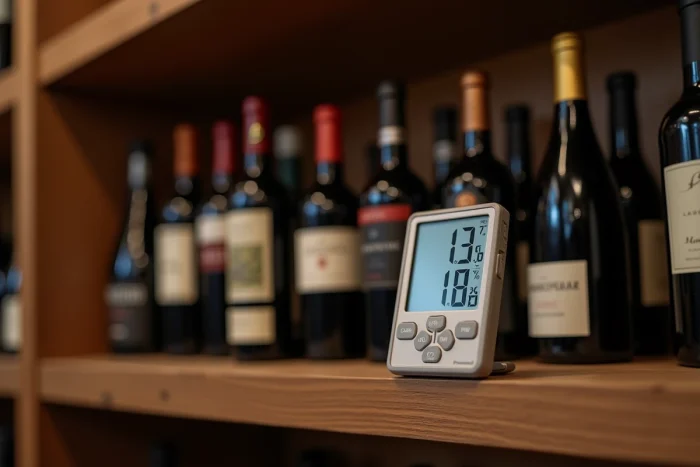
Hygrometry: the forgotten parameter that protects your corks
Temperature captures all the attention, but humidity plays a similarly structuring role for long-term storage. Air that is too dry dries out the cork. The cork shrinks, loses its seal, and the wine oxidizes, even if the temperature is perfect.
The recommended range is between 60 and 75% relative humidity. Below 60%, the cork weakens. Above 75%, labels can mold and capsules can corrode, without the wine itself necessarily being altered.
In a natural underground cellar, hygrometry often regulates itself thanks to the moisture in the soil. In an electric cellar or a converted space, a small water tray or a passive humidifier can help maintain the level within the right range. Some models of electric cellars now include a humidity management system, confirming that the temperature-hygrometry pair has become the standard for storage.
The next time you check your cellar’s thermostat, remember to also look at the hygrometer. A wine stored at 12 °C in air at 40% humidity ages less well than a wine stored at 13 °C with the correct humidity. The overall stability of the environment matters more than an isolated number on the thermometer.