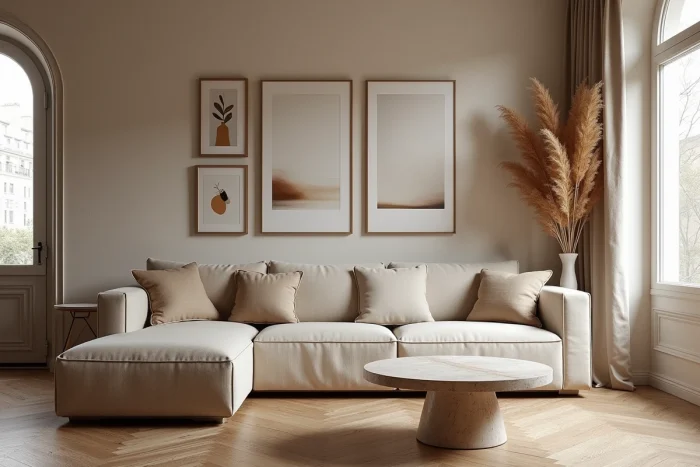
A corduroy sofa placed on a terrazzo floor, a raw stone vase next to a polished brass light fixture: these combinations perfectly summarize the direction taken by recent interior decor. Current trends no longer settle for a single palette or style. They invite layering different registers, mixing textures, and asserting a personal stance in each room.
Natural materials and refined finishes: the duo that transforms a living room
Have you noticed that raw wood, linen, or stone seem omnipresent in decor magazines? The trend is not new, but its treatment has changed. The classic trap was to accumulate raw materials and achieve a rustic, almost austere result. The recent approach corrects this flaw by combining natural materials and more sophisticated finishes.
A solid oak tabletop gains elegance when its edges are beveled and waxed. A stone accent wall takes on another dimension against a brushed metal sconce. The contrast between the raw and the polished creates a visual tension that makes the space lively without overwhelming it.
In practical terms, the principle is simple: choose an organic material as a base (wood, rattan, linen, terracotta), then pair it with an element that has a smooth or shiny finish (brass, smoked glass, glazed ceramic). It’s also a way to explore decorating with Maisons Euro France to identify pieces that play on these contrasts.
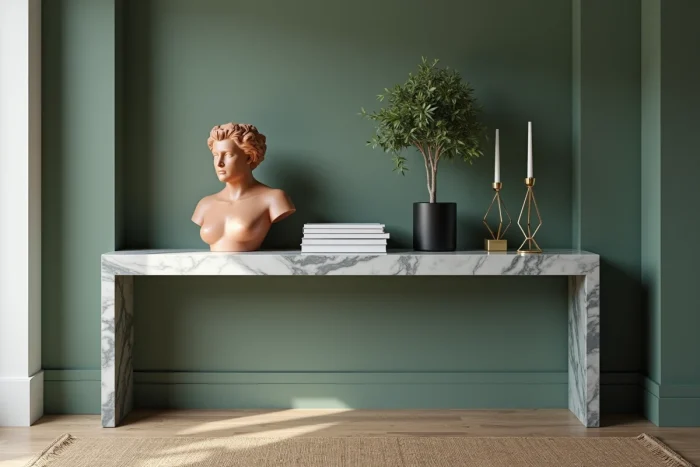
Decorative textiles: an underestimated lever for structuring a room’s ambiance
A curtain, a bed throw, a cushion – we often choose them by default, at the end of a project. Their role goes far beyond comfort. Textiles structure the ambiance as much as furniture does. A washed linen in a living room brings softness. A cotton gauze in a bedroom creates an airy effect that is hard to achieve otherwise.
Why this change in status? Textiles offer the flexibility that furniture does not allow. Changing a duvet cover or curtains costs little and transforms a room in minutes. It’s the quickest way to follow a color or pattern trend without heavy commitment.
Choosing the right textile for the room
- For the living room, favor fabrics with visible grain (wrinkled linen, textured cotton, corduroy) that capture light and add depth to the sofa or armchairs.
- In the bedroom, cotton gauze or washed satin creates a delicate look while remaining pleasant to the touch for bedding.
- In an office or reading nook, a merino wool throw or a tweed cushion adds a warm note without cluttering the space.
A well-chosen textile can sometimes replace a piece of furniture. A large throw draped over a neutral armchair gives it a personality that the upholstery alone did not provide.
Deep color palettes and soft atmospheres for a modern interior
Neutral shades have not disappeared, but they now share the stage with bolder colors. Recent palettes revolve around warm and enveloping tones: muted terracotta, dark burgundy, sage green, chocolate brown. These colors have one thing in common: they absorb light instead of reflecting it, creating a cozy atmosphere.
A common mistake is to paint all four walls of a room in a dark shade. The result crushes the volume. One wall in a deep color is enough to anchor the space. The remaining walls, left in a light tone, serve as visual breathing space.
Combining colors without bad taste
The most reliable principle remains that of dominant-secondary-accent relationship. The dominant color occupies large surfaces (walls, floor). The secondary appears on the main furniture. The accent is limited to a few objects (vase, cushion, frame).
A living room with off-white walls (dominant), a sage green sofa (secondary), and two terracotta cushions (accent) works effortlessly. Limiting the palette to a maximum of three tones avoids visual cacophony.
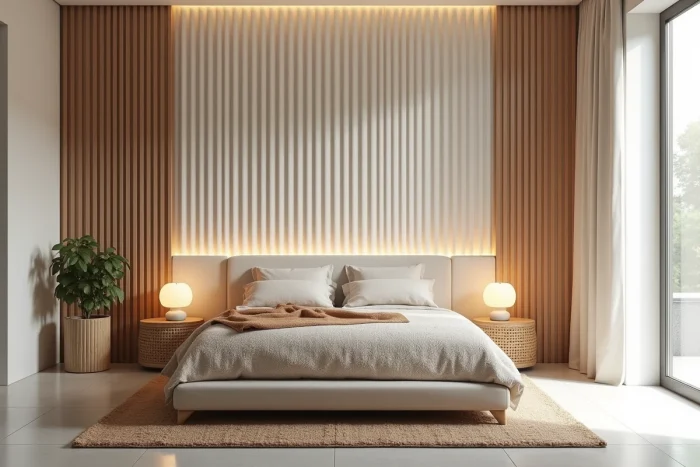
Wall decoration and wallpaper: asserting a style without overwhelming
Wallpaper is making a comeback with more graphic patterns and formats designed to cover only a portion of the wall. Geometric patterns, wide stripes, or botanical prints work particularly well on an accent wall, behind a bed, or in an entryway.
Wall art follows the same selection logic. Rather than hanging a dozen mismatched frames, the current trend favors two or three medium-sized pieces, spaced apart, that engage with each other through color or theme.
- A black and white photographic triptych above a low sideboard creates a clear focal point.
- A large framed poster in a thin light wood frame lightens a dark wall.
- A large round mirror, placed against the wall rather than fixed, adds depth to a narrow hallway.
Wall decoration serves as a visual signature. Choosing a few well-positioned pieces has more impact than an accumulation.
Personalizing each room without following a unique diktat
The most striking trend may be that of individualization. Inspirations circulate through blogs, community platforms, and editorial selections, far beyond major trade shows. This broad dissemination gives access to a wide variety of ideas, but it also makes copying more visible.
It’s better to retain one or two strong stances per room than to fully replicate an interior seen online. A living room can focus on material contrast. A bedroom can play the textile card. The kitchen can embrace graphic tiling from floor to wall. Each room deserves its own decor angle, even in a home with modest volumes.
Recent decor trends share a common thread: they favor bold choices rather than lukewarm compromises. A colored wall, a textile that structures, a raw material enhanced by a refined finish – these are simple, accessible gestures that transform an interior without distorting it.